Matrix puzzle rules: track one feature at a time
Updated October 12, 2026 · Reading time: 6 min · 6 sections
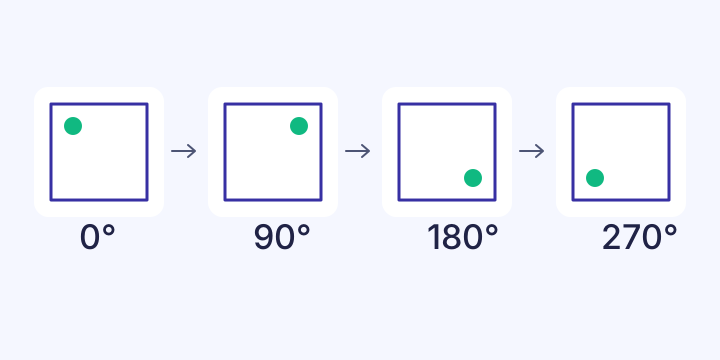
A square can rotate and look exactly the same. Add a dot in one corner, and the movement becomes visible. Matrix puzzles often depend on noticing that small difference.
Which features should I compare in a matrix?
I start by making a short inventory: outline, fill, count, size, orientation and position. A tile containing a circle with a small corner marker has at least two components. The circle may be fixed while the marker moves. Treating it as one symbol can hide the operation; separating those features gives you something concrete to compare across examples.
Look at a complete row, column or pair before focusing on the missing tile. Record what stays constant and what changes. If every outline is a square but the fill changes, shape is probably not the distinguishing feature. If the number of marks increases while the arrangement changes to fit them, count may be the intended feature rather than spacing.
A useful description is specific enough to fail when it is wrong. “The pictures change” explains nothing. “The marker moves one corner clockwise while the outline and fill remain fixed” can be checked against every visible step. The practice puzzles give an explicit rule after the attempt, so you can compare your proposed description with the intended one instead of only seeing a green or red verdict.
| Feature | Ask this question | A useful observation |
|---|---|---|
| Outline | Which shape is present? | One circle, one square and one triangle per row |
| Fill | Is it outlined or filled? | A column keeps the same fill |
| Count | How many components? | One more marker at each step |
| Position | Where is the marker? | It visits corners clockwise |
| Size | Which dimension changes? | The side grows by a constant amount |
How do rotation and reflection differ?
A quarter-turn moves an upper-left corner marker to upper-right, then lower-right, then lower-left as it continues clockwise. A reflection across a vertical center line swaps left and right while keeping height. The same starting marker can therefore move to upper-right under either operation on the first step. More examples are needed to separate the possibilities.
Inspect a second component or the next pair. A right-handed arrangement can reverse handedness under reflection, while a rotation carries the whole arrangement around without that reversal. A simple symmetrical shape can conceal the distinction, so seek an asymmetric marker, a slanted line or two components of different shapes.
Be precise about the reflection axis. Across a vertical axis, left changes to right and up remains up. Across a horizontal axis, up changes to down and left remains left. Across a diagonal axis, coordinates interchange. Do not assume “mirror image” always means a left-right swap unless the instruction or examples establish the axis.
How do I combine shape and fill rules?
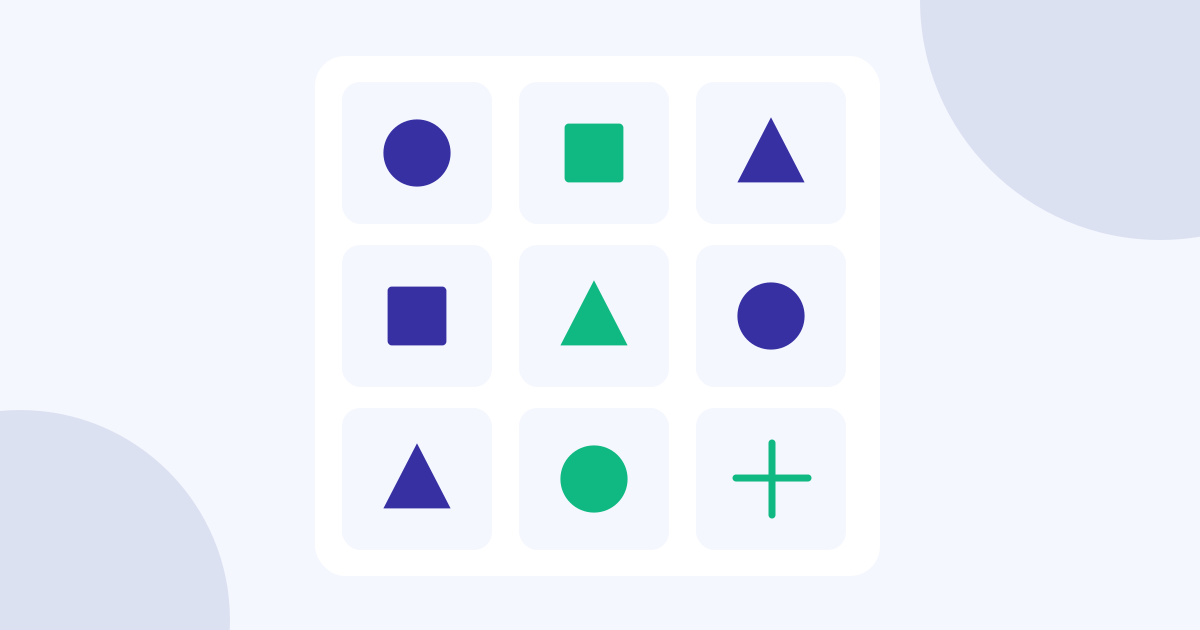
Imagine a three-by-three grid where every row contains a circle, a square and a triangle exactly once, and each column uses one fixed fill. The missing cell must satisfy both the absent shape in its row and the column’s fill. Choosing the right shape with the wrong fill meets only half the rule. The answer tiles are designed to make that distinction visible.
Check a proposed column rule against every known cell in that column. If a complete column already contains both fills, a statement that each column must contain both fills may add no constraint to a third cell. In that case it cannot determine the final fill. Good explanations should say what the examples actually establish, rather than using a vague condition that accidentally allows two answers.
For a sequence displayed over two rows, the reading order also matters. Some layouts continue left to right and then wrap to the next row; others establish a relationship within each row. Follow the instruction and inspect a complete example. Do not impose the usual matrix interpretation on a wrapped one-dimensional sequence solely because its tiles happen to make a rectangle.
How do I solve visual analogies?
In a visual analogy, identify the operation from A to B before examining the choices for C. Suppose a large filled circle becomes a smaller filled circle. You know the shape and fill stayed fixed; size changed. A small outlined square is a distractor if the second pair begins with a filled square and the demonstrated operation did not remove fill.
If exact dimensions are given or visibly constructed to support a ratio, preserve that ratio. Shrinking a diameter from thirty to twenty is a factor of two-thirds. A square side of thirty-six would become twenty-four under the same operation. A simple “make it smaller” explanation is less precise, but a puzzle should not demand an exact ratio that its illustrations fail to show consistently.
Other analogies add a marker, remove an interior line, exchange fill and outline, or rotate a component. Track changes and invariants separately. Adding a second marker does not imply moving the first one, changing the large shape or filling its outline. The answer must repeat the demonstrated change without smuggling in additional transformations.
Can a puzzle have more than one possible answer?
A short visual series can admit more than one constructed explanation. In a practical multiple-choice task, the intended answer is usually supported by a simple consistent rule and the available options. That is different from proving that every imaginable continuation would be impossible. If two options are visually identical or two satisfy all stated conditions, the item needs repair rather than a more elaborate excuse.
I check candidate rules in both directions when possible. A condition that fits the complete rows should also produce the missing row correctly. A transformation from A to B should preserve the demonstrated properties when applied to C. If the explanation changes halfway through, pause and consider another feature instead of forcing the nearest-looking option.
Colour alone should not be treated as a psychological ability measure. It is a feature used by some of these practice drawings, and viewing conditions can affect it. If two fills are hard to distinguish on your screen, zoom or use a clearer display. A result from poorly seen artwork is not evidence about intelligence. The score interpretation guide explains the limits of this practice set.
How can I learn from a wrong answer?
After an attempt, open the individual review and compare your chosen diagram with the intended one. Ask which specific feature differs. Did you identify the correct shape but miss its fill? Did a corner marker move in the opposite direction? Did you use the first row’s count while ignoring the second row’s operation? That diagnosis of the reasoning step is more useful than a broad label such as “bad at matrices.”
Write a one-sentence rule before looking at the explanation on a repeat. Familiarity can otherwise make the answer feel obvious without clarifying why. The sequence guide uses the same habit for numbers: check a relationship across all examples before predicting the next one. Neither faster recognition nor a better repeat score establishes a change in standardized IQ.
FAQ
Does the outline always reveal rotation?
No. A symmetrical outline may look unchanged; follow an asymmetric marker or line.
What if two choices fit the rule?
The item may be ambiguous. A clear explanation should satisfy every stated constraint and distinguish the intended choice.
Do matrix results measure a specific ability here?
No. The four-item family subtotal is a review index, not a validated ability score.