Number sequence strategies beyond guessing the next term
Updated October 12, 2026 · Reading time: 6 min · 7 sections

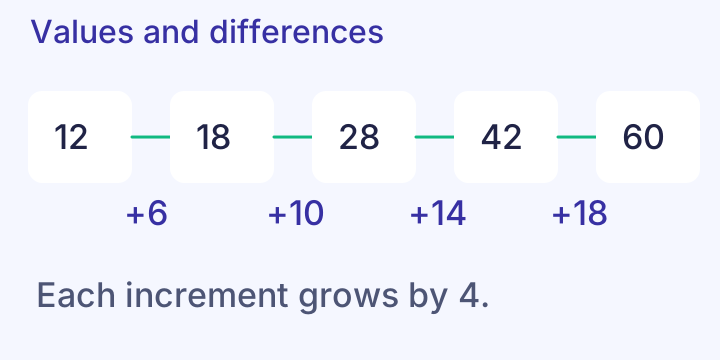
For 12, 18, 28 and 42, looking only at the last jump encourages guessing. Writing all the differences—6, 10 and 14—reveals a much cleaner candidate rule.
How do I use differences to find the next number?
I subtract consecutive terms before inventing a complicated pattern. Here the differences are eighteen minus twelve, twenty-eight minus eighteen and forty-two minus twenty-eight: six, ten and fourteen. Those differences increase by four. Continuing that relationship gives a next difference of eighteen, so the next term under the intended rule is sixty.
A constant first difference suggests an arithmetic progression. For seven, eleven, fifteen and nineteen, the repeated addition is four and the next term is twenty-three. A constant second difference suggests a different relationship: the increments themselves change by a fixed amount. You do not need to name a polynomial to use that observation, but you do need to check every available difference.
The last pair alone is weak evidence. Many candidate rules produce the same final jump while disagreeing with earlier terms. Verify a proposed operation from the first term onward. If it fits only the last transition, it has not yet explained the sequence. The free reasoning practice shows the intended numeric rule in the answer review after the attempt.
| Term | Value | Difference from previous |
|---|---|---|
| 1 | 12 | — |
| 2 | 18 | 6 |
| 3 | 28 | 10 |
| 4 | 42 | 14 |
| 5, under this rule | 60 | 18 |
When should I try multiplication?
For five, fifteen, forty-five and one hundred thirty-five, the ratios are all three. Multiplying the last term by three gives four hundred five. The differences grow too, but a constant ratio is the simpler direct description. A candidate ratio must fit every step, not merely resemble a large jump near the end.
Ratios need care around zero. Dividing by a previous term of zero is undefined, so you cannot conclude that a sequence beginning at zero lacks a multiplicative component simply because that division fails. Negative terms can introduce sign alternation: three, minus six, twelve and minus twenty-four multiply by minus two, giving forty-eight next.
If multiplication produces a consistent additive adjustment as well, test both parts explicitly. Four, nine, nineteen and thirty-nine follow “multiply by two, then add one.” The next value is seventy-nine. Multiplication alone would predict seventy-eight and would not explain the earlier values. Reconstructing each step is the fastest way to spot that missing adjustment.
How do I solve alternating number sequences?
Consider two, twenty, five, seventeen, eight and fourteen. The odd-position terms are two, five and eight, increasing by three. The even-position terms are twenty, seventeen and fourteen, decreasing by three. Under that paired rule, the next odd-position term is eleven. Treating adjacent terms as one ordinary progression would produce irregular jumps that conceal the structure.
Write positions above the terms if the sequence is long enough to become confusing. Odd and even positions are separate from odd and even numeric values. An odd-position term can be an even number. This distinction matters when a sequence deliberately alternates kinds of values or operations.
Alternating operations can also act on one running sequence. A rule might add three, then multiply by two, then add three again. Test the complete cycle more than once before accepting it. One add-and-multiply pair does not establish a repeating rule on its own. The number of available terms and the choices determine how confidently you can identify the intended continuation.
When do I add the previous two terms?
A sum-of-two-previous-terms rule uses a pair as its state. With starting terms two and three, the next terms are five, eight, thirteen and twenty-one. Each new term combines the two immediately before it. The next is thirty-four. You cannot reconstruct the sequence from a single final multiplier because the ratio is changing.
Other recurrences use subtraction, alternating signs or a fixed coefficient on an earlier term. Avoid reaching for those possibilities before checking simpler repeated differences and ratios. A short multiple-choice practice question is usually easier to explain with one clear relationship than with a large expression chosen merely to fit every existing value.
Position formulas can help when terms resemble squares, cubes or products of neighboring integers. If a sequence is described as the square of its position plus two, positions one through four produce three, six, eleven and eighteen; position five produces twenty-seven. Verify the starting position rather than assuming the first visible value must correspond to position zero.
How should I use the answer choices?
After finding a candidate continuation, compare it with the available choices. A common distractor follows only the last difference or repeats the last multiplier. Another may be close in value but ignore a sign. Calculate the intended next term before looking for the nearest-looking option; that reduces the temptation to justify an attractive answer after selecting it.
If the choices are shuffled, the letters are only temporary labels. An explanation should identify the value or operation rather than rely on “option B” being correct forever. The practice tool keeps a session’s answer ordering stable on resume and records the original choice internally, so revisiting a question does not accidentally change what you selected.
Check arithmetic separately from pattern recognition. You can find the correct recurrence and then add the wrong two terms. Writing the intermediate difference, ratio or sum makes that mistake visible. If a puzzle asks for a numerical value inside a visual matrix, identify the row or pair relationship before applying the same sequence habits.
Can a number sequence have more than one answer?
Given enough freedom, many formulas can pass through a finite list of numbers and assign different next values. Practical sequence puzzles rely on an intended economical rule, often constrained by their answer choices. Recognizing that limitation does not make the exercise useless; it changes what the answer explanation should claim.
I would reject an item with two equally supported options rather than pretend that a complicated hidden convention makes one uniquely correct. Good practice explanations show a relationship that fits every example and state the operation plainly. A result tells you whether you matched that intended relationship in the set, not whether you have solved a universal mathematical uniqueness problem.
Timed and untimed attempts can feel different because a deadline changes how long you inspect candidate rules. Repeating the same list also introduces memory. Compare your reasoning process, not just the raw score. The practice score guide explains why neither a sequence subtotal nor a quick repeat can be converted into an IQ number.
What should I check first in a number sequence?
First inspect all adjacent differences. Then inspect ratios where division is meaningful. Next try differences of differences, alternating positions or a relationship involving the previous two terms. Only then consider a position formula if the values visibly suggest one. This is an order of convenient checks, not a guarantee that every puzzle fits a fixed taxonomy.
For visual tasks, the same discipline becomes a feature inventory rather than arithmetic subtraction. The matrix guide separates shape, fill, count and movement. In both cases, the useful habit is to test a precise rule against complete examples before applying it to the missing one.
FAQ
Should I always check differences first?
It is a useful first check, not a universal rule. Ratios, alternating positions and recurrences can describe other sequences.
Can a finite sequence have another continuation?
Yes. Practical puzzles ask for an intended simple relationship, not a proof that no constructed alternative exists.
Does the answer letter remain fixed?
No. Choices are shuffled for a new session; the value and intended operation remain the relevant evidence.