A practice score and an IQ score answer different questions
Updated October 12, 2026 · Reading time: 6 min · 6 sections

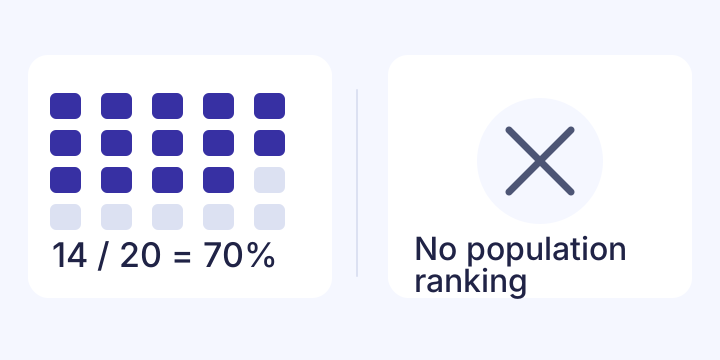
Fourteen correct answers out of twenty gives 70% correct. It does not place you at the seventieth percentile, and it cannot be converted into an IQ of seventy.
What does a raw practice score mean?
I read a practice result by starting with its denominator. Here there are twenty fixed puzzles and each correct intended answer earns one point. Fourteen correct gives 14/20, and fourteen divided by twenty times one hundred gives 70%. The number describes performance on these exact items under the chosen conditions.
A percentile is a different quantity. It describes a position relative to a defined reference group and a scoring procedure. Percent correct can be calculated without testing anyone else; a credible population comparison requires evidence about the reference group. This site has no validated population norms, so it reports no percentile and no claimed “top percentage of people.”
An IQ score belongs to a standardized assessment’s scoring system. A formula such as 70 + 60 × (correct answers ÷ total answers) would turn 14/20 into 70 + 60 × 0.7 = 112. That arithmetic is reproducible, but it supplies no calibration, reliability or validity evidence. A disclaimer below it does not make the conversion scientifically meaningful. The practice tool therefore keeps the raw result visible and explains every item instead.
| Quantity | What it answers | Available here? |
|---|---|---|
| Raw correct count | How many intended answers matched? | Yes, out of twenty |
| Percent correct | What fraction of this set matched? | Yes |
| Population percentile | Where does a score sit in a reference group? | No validated reference group |
| Standardized IQ score | What does an assessment’s calibrated scale report? | No |
| Family subtotal | Which four-item review deserves attention? | Yes, with explicit limits |
Does finishing faster change the score?
A timed attempt ends at a fifteen-minute deadline and counts time while the page is in the background or closed. Untimed practice allows more inspection and resumes without including the closed-page gap in its displayed elapsed time. Those are different conditions, so compare them cautiously even when they use the same items.
The scoring does not reward speed separately. The same answer vector earns the same raw score in either mode. A quick completion with mistakes does not receive an invented IQ boost, and a slow careful completion does not imply low intelligence. The clock is useful for describing your session, not for manufacturing a population norm.
Skipped items remain in the twenty-item denominator. If you answer ten correctly and leave ten unanswered, the result is 10/20, or 50%, with answered count ten. Reporting 100% merely because every attempted item was correct would conceal half the set. The result shows unanswered count separately so you can distinguish an unfinished attempt from twenty recorded choices.
What do the five category scores tell me?
Each family contains four puzzles. A subtotal of three out of four is 75% in that tiny group; one different answer moves it to 50% or 100%. The display organizes your review, but the size and design of the set do not justify calling it a precise measure of pattern recognition, spatial intelligence or numerical ability.
Content also matters. These items sample specific visual and number relationships, not every kind of reasoning, knowledge or functioning an assessment might examine. Familiarity with a particular sequence, difficulty distinguishing fills, language comprehension and screen size can affect an attempt. A low subtotal should prompt inspection of the missed task rather than a broad statement about a person.
I use the family labels as an index: open the missed explanation and identify the feature or operation that was overlooked. “The marker moved clockwise, but I reflected it” is an actionable observation. “My spatial ability is weak” is a much larger claim that this four-item sample cannot establish. The matrix guide helps turn that review into a concrete reasoning check.
Why does my score improve when I repeat the test?
A second attempt uses the same underlying twenty items, although answer positions change. You may remember a diagram, an intended rule or a numerical answer. That can improve the raw result without providing evidence that general intelligence has changed. The score remains a useful record of this practice activity, but its interpretation should not expand beyond the evidence.
If you want to compare approaches, keep the conditions similar and record what changed in your reasoning. Did you start checking all row constraints? Did you write differences instead of guessing? Did you use untimed mode to inspect a rotation? Those process observations are more defensible than subtracting two invented IQ numbers and declaring an improvement.
Random guessing offers another useful arithmetic distinction. With four equally likely choices and one intended answer, an independent random choice has probability one quarter of matching that item. Across twenty items the expected correct count is five. That is an expectation under a hypothetical guessing model, not a cutoff for intelligence or a prediction that every guesser will score exactly five.
How does practice differ from a supervised IQ test?
Mensa International’s challenge explicitly describes its online activity as entertainment and says its result does not qualify someone for membership. British Mensa’s free workout also distinguishes the free exercise from an IQ score. These examples support clear expectations; this site is independent of Mensa.
It would be inaccurate to say that every online assessment is necessarily casual or unsupervised. British Mensa separately describes a proctored secure online test. The meaningful distinction is the assessment, its evidence and its administration, not merely whether the questions appear in a browser.
If you need a result for an educational, employment or clinical decision, ask the relevant organization or an appropriately qualified professional which assessment and administration are suitable. This practice activity is not a diagnosis, eligibility document or professional recommendation. It cannot establish giftedness, a cognitive disability or a health condition from a raw puzzle count.
What does the downloaded result card show?
The local result image says “reasoning practice result,” gives the correct count and family subtotals, and repeats that it is not a standardized IQ score. It contains no invented professional endorsement, percentile band or certificate number. The text summary repeats the same limits. Sharing it shares a practice record, not evidence of an official assessment.
Progress and explicitly saved summaries remain in local browser storage. They are not an account record and can disappear if storage is blocked or cleared. Clear them on a shared device. No answer upload is needed for the tool to compute a count or draw a review; the scoring is simple enough to inspect in the worked reasoning examples and the item explanations themselves.
An honest raw result can still be satisfying. It gives you a finished challenge, a record of your choices and an explanation of the rules. Keeping that scope clear is what makes the number useful: you can see what it measures, reproduce its arithmetic and decide what to practice next without turning a small puzzle set into a label for your life.
FAQ
Does 70% correct mean the seventieth percentile?
No. Percent correct concerns the item set; percentile concerns a defined reference group.
Can the timer change the score?
Timing changes the session conditions. Every matched intended answer still earns one point, with no speed bonus.
Does the result card certify my IQ?
No. It records a reasoning practice attempt and explicitly says it is not a standardized IQ score.